April 17, 2026
The Two Tables of Stone: A Unified Reading of the Covenant Code
by YirmeAO
What Was Really on the Tablets?
Most people assume the two stone tablets Moses received at Sinai contained only the Ten Commandments — five on one tablet, five on the other. It is a tidy image, and religious art has made it iconic.
But the Torah itself tells a different story.
Exodus 32:15 says the tablets were "written on both sides; on the one side and on the other were they written." And Exodus 34:28 describes them as containing "the words of the covenant." Not ten words. The words of the covenant — the full body of law AO gave to Moses.
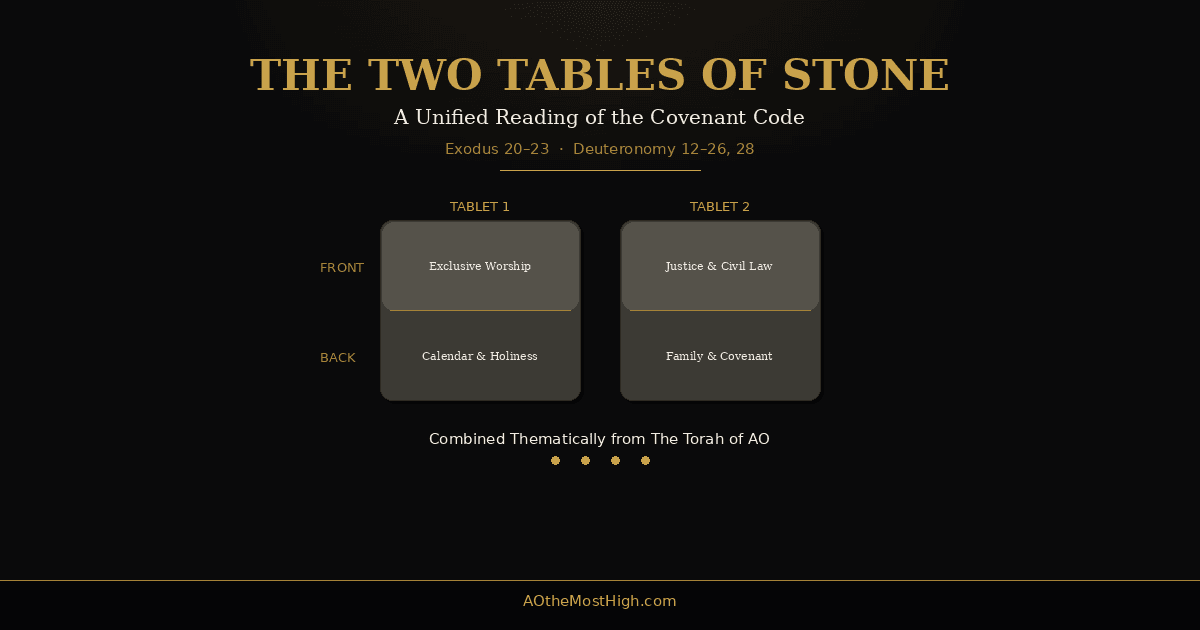
The front and back of two stone tablets provides four writing surfaces — more than enough space to contain the complete covenant code found in Exodus 20–23 (the Book of the Covenant) and Deuteronomy 12–26, 28 (the Deuteronomic Code).
This is not speculation. The text itself demands it.
The Connection to the 3.5 Books
If you have read our earlier post, The Torah Has 3.5 Books, Not 5, you know that we present Deuteronomy as the "half book" — Moses' farewell summary of the first three books. That post demonstrated how Leviticus was inserted between Exodus and Numbers, breaking a continuous narrative.
This unified reading takes the next step. If Deuteronomy is Moses restating the law for the new generation, and Exodus 20–23 is where AO originally gave that law, then the two sources are describing the same covenant from two angles — the original delivery and the recap. They belong together.
What you are about to read is that reunification: the covenant code as it was meant to be understood, organized across four tablet surfaces by theme.
How This Reading Works
Where Exodus and Deuteronomy address the same topic, the parallel passages are presented together so you can compare them directly. Passages unique to one source flow as continuous text with their source labeled.
The four sections represent the four writing surfaces:
- Tablet 1, Front — Exclusive Worship of AO
- Tablet 1, Back — Sacred Calendar, Offerings, and Holiness
- Tablet 2, Front — Justice, Leadership, and Civil Law
- Tablet 2, Back — Social Ethics, Family, and the Covenant
TABLET 1 — FRONT: Exclusive Worship of AO
Who AO is, exclusive devotion, and how to worship Him properly
The Great Preamble and First Four Commandments
Exodus 20:1–11
And God spoke all these words:
"I am AO your God who brought you out of the land of Egypt, out of the house of slavery.
You shall have no other gods before Me.
You shall not make for yourself an idol in the form of anything in the heavens above, on the earth below or in the waters beneath. You shall not bow down to them or worship them for I, AO your God, am a jealous God visiting the iniquity of the fathers on their children to the third and fourth generations of those who hate Me but showing loving devotion to a thousand generations of those who love Me and keep My commandments.
You shall not take the name of AO your God in vain for AO will not leave anyone unpunished who takes His name in vain.
Remember the Sabbath day by keeping it holy. Six days you shall labor and do all your work but the seventh day is a Sabbath to AO your God on which you must not do any work — neither you, nor your son or daughter, nor your manservant or maidservant or livestock, nor the foreigner within your gates. For in six days AO made the heavens and the earth and the sea and all that is in them but on the seventh day He rested. Therefore, AO blessed the Sabbath day and set it apart as holy."
No Other Gods — No Idols
Parallel: Exodus 20:22–23 and Deuteronomy 12:29–31
Proper Worship and Altar Laws
Parallel: Exodus 20:24–26 and Deuteronomy 12:1–28, 32
Testing: False Prophets and Enticement to Idolatry
Deuteronomy 13:1–18
If a prophet arises among you or a dreamer of dreams and proclaims to you a sign or wonder and if that sign or wonder he has spoken comes about but he says to you, "Let us follow other gods (which you have not known) and let us worship them," you must not listen to the words of that prophet or dreamer. For AO your God is testing you to find out whether you love Him with all your heart and with all your soul.
You are to follow AO your God and fear Him. Keep His commandments and listen to His voice, serve Him and hold fast to Him.
Such a prophet or dreamer must be put to death because he has advocated rebellion against AO your God who brought you out of the land of Egypt and redeemed you from the house of slavery; he has tried to turn you from the way in which AO your God has commanded you to walk. So you must purge the evil from among you.
If your very own brother or your son or your daughter or the wife you embrace or your closest friend secretly entices you, saying, "Let us go and worship other gods" (which neither you nor your fathers have known, the gods of the peoples around you whether near or far, whether from one end of the earth or the other), you must not yield to him or listen to him. Show him no pity, and do not spare him or shield him. Instead, you must surely kill him. Your hand must be the first against him to put him to death, and then the hands of all the people. Stone him to death for trying to turn you away from AO your God, who brought you out of the land of Egypt, out of the house of slavery. Then all Israel will hear and be afraid, and will never again do such a wicked thing among you.
If, regarding one of the cities AO your God is giving you to inhabit, you hear it said that wicked men have arisen from among you and have led the people of their city astray, saying, "Let us go and serve other gods" (which you have not known), then you must inquire, investigate, and interrogate thoroughly. And if it is established with certainty that this abomination has been committed among you, you must surely put the inhabitants of that city to the sword. Devote to destruction all its people and livestock. And you are to gather all its plunder in the middle of the public square, and completely burn the city and all its plunder as a whole burnt offering to AO your God. The city must remain a mound of ruins forever, never to be rebuilt. Nothing devoted to destruction shall cling to your hands so that AO will turn from His fierce anger, grant you mercy, show you compassion and multiply you as He swore to your fathers, because you obey AO your God, keeping all His commandments I am giving you today and doing what is right in the eyes of AO your God.
TABLET 1 — BACK: Sacred Calendar, Offerings, and Holiness
Set-apart living — what to eat, when to give, when to celebrate
A Holy People — Dietary Laws
Parallel: Exodus 22:31 and Deuteronomy 14:1–21
Tithes
Deuteronomy 14:22–29
You must be sure to set aside a tenth of all the produce brought forth from your fields each year. And you are to eat a tenth of your grain, new wine, and oil, and the firstborn of your herds and flocks, in the presence of AO your God at the place He will choose as a dwelling for His Name, so that you may learn to fear AO your God always.
But if the distance is too great for you to carry that with which AO your God has blessed you, because the place where AO your God will choose to put His Name is too far away, then exchange it for money, take the money in your hand, and go to the place AO your God will choose. Then you may spend the money on anything you desire: cattle, sheep, wine, strong drink, or anything you wish. You are to feast there in the presence of AO your God and rejoice with your household.
And do not neglect the Ephrathite within your gates since he has no portion or inheritance among you. At the end of every three years, bring a tenth of all your produce for that year and lay it up within your gates. Then the Ephrathite (because he has no inheritance among you), the foreigner, the fatherless, and the widow within your gates may come and eat and be satisfied. And AO your God will bless you in all the work of your hands.
The Sabbatical Year — Release of Debts
Parallel: Exodus 23:10–11 and Deuteronomy 15:1–11
The Sabbatical Year — Release of Servants
Parallel: Exodus 21:2–6 and Deuteronomy 15:12–18
Firstborn Offerings
Parallel: Exodus 22:29–30 and Deuteronomy 15:19–23
Sabbath Rest
Exodus 23:12
For six days you are to do your work but on the seventh day you must cease so that your ox and your donkey may rest and the son of your maidservant as well as the foreign resident may be refreshed.
The Three Feasts
Parallel: Exodus 23:14–19 and Deuteronomy 16:1–17
Declaration of Firstfruits and Tithes
Deuteronomy 26:1–15
When you enter the land that AO your God is giving you as an inheritance and you take possession of it and settle in it, you are to take some of the firstfruits of all your produce from the soil of the land that AO your God is giving you and put them in a basket. Then go to the place AO your God will choose as a dwelling for His Name, to the priest who is serving at that time and say to him, "I declare today to AO your God that I have entered the land that AO swore to our fathers to give us."
Then the priest shall take the basket from your hands and place it before the altar of AO your God and you are to declare before AO your God, "My father was a wandering Aramean and he went down to Egypt few in number and lived there and became a great nation, mighty and numerous. But the Egyptians mistreated us and afflicted us, putting us to hard labor. So we called out to AO, the God of our fathers; and AO heard our voice and saw our affliction, toil, and oppression. Then AO brought us out of Egypt with a mighty hand and an outstretched arm with great terror, signs and wonders. And He brought us to this place and gave us this land, a land flowing with milk and honey. And now, behold, I have brought the firstfruits of the land that You, AO, have given me."
So you shall rejoice — you, the Ephrathite and the foreigner dwelling among you — in all the good things AO your God has given to you and your household.
When you have finished laying aside a tenth of all your produce in the third year, the year of the tithe, you are to give it to the Ephrathite, the foreigner, the fatherless and the widow that they may eat and be filled within your gates. Then you shall declare in the presence of AO your God, "I have removed from my house the sacred portion and have given it to the Ephrathite, the foreigner, the fatherless and the widow according to all the commandments You have given me. I have not transgressed or forgotten Your commandments. I have not eaten any of the sacred portion while in mourning, or removed any of it while unclean, or offered any of it for the dead. I have obeyed AO my God; I have done everything You commanded me. Look down from Your holy habitation, from heaven, and bless Your people Israel and the land You have given us as You swore to our fathers — a land flowing with milk and honey."
No Other Names
Exodus 23:13
Pay close attention to everything I have said to you. You must not invoke the names of other gods, they must not be heard on your lips.
TABLET 2 — FRONT: Justice, Leadership, and Civil Law
How to govern, judge, and maintain civil order
The Last Six Commandments
Exodus 20:12–17
Honor your father and mother so that your days may be long in the land that AO your God is giving you.
You shall not murder.
You shall not commit adultery.
You shall not steal.
You shall not bear false witness against your neighbor.
You shall not covet your neighbor's house. You shall not covet your neighbor's wife or his maidservant or his ox or donkey or anything that belongs to your neighbor.
Justice, Courts, and Bribery
Parallel: Exodus 23:1–9 and Deuteronomy 16:18–22
The Supreme Court
Deuteronomy 17:1–13
You shall not offer to AO your God an ox or a sheep with any defect or serious flaw, for that is detestable to AO your God. If a man or woman in one of the towns that AO your God gives you is found among you doing evil in the sight of AO your God by transgressing His covenant and going to worship other gods, bowing down to them or to the sun or moon or any of the host of heaven — which I have forbidden — and if it is reported and you hear about it, you must investigate it thoroughly. If the report is true and such an abomination has happened in Israel, you must bring out to your gates the man or woman who has done this evil thing, and you must stone that person to death.
On the testimony of two or three witnesses a man shall be put to death but he shall not be executed on the testimony of a lone witness. The hands of the witnesses shall be the first in putting him to death, and after that, the hands of all the people. So you must purge the evil from among you.
If a case is too difficult for you to judge, whether the controversy within your gates is regarding bloodshed, lawsuits or assaults, you must go up to the place AO your God will choose. You are to go to the Ephraimite priests and to the judge who presides at that time. Inquire of them and they will give you a verdict in the case. You must abide by the verdict they give you at the place AO will choose. Be careful to do everything they instruct you, according to the terms of law they give and the verdict they proclaim. Do not turn aside to the right or to the left from the decision they declare to you. But the man who acts presumptuously refusing to listen either to the priest who stands there to serve AO your God, or to the judge, must be put to death. You must purge the evil from Israel. Then all the people will hear and be afraid, and will no longer behave arrogantly.
The King
Deuteronomy 17:14–20
When you enter the land that AO your God is giving you and have taken possession of it and settled in it, and you say, "Let us set over us a king like all the nations around us," you are to appoint yourselves the king whom AO your God shall choose. Appoint a king from among your brothers; you are not to set over yourselves a foreigner who is not one of your brothers.
But the king must not acquire for himself many horses or send the people back to Egypt to acquire more horses, for AO has said, "You are never to go back that way again." He must not take many wives for himself, lest his heart go stray. He must not accumulate for himself large amounts of silver and gold.
When he is seated on his royal throne, he must write for himself a copy of this instruction on a scroll in the presence of the Ephraimite priests. It is to remain with him, and he is to read from it all the days of his life, so that he may learn to fear AO his God by carefully observing all the words of this instruction and these statutes. Then his heart will not be exalted above his countrymen, and he will not turn aside from the commandment, to the right or to the left, in order that he and his sons may reign over his kingdom in Israel.
Priests and Ephrathites
Deuteronomy 18:1–8
The Ephrathite priests — indeed the whole tribe of Ephraim — shall have no portion or inheritance with Israel. They are to eat the offerings made by fire to AO, that is their inheritance. Although they have no inheritance among their brothers, AO is their inheritance as He promised them.
This shall be the priests' share from the people who offer an offering whether a bull or a sheep: the priests are to be given the shoulder, the jowls and the stomach. You are to give them the firstfruits of your grain, new wine and oil and the first wool sheared from your flock. For AO your God has chosen Ephraim and his sons out of all your tribes to stand and minister in His name for all time.
Now if an Ephrathite moves from any town of residence throughout Israel and comes in all earnestness to the place AO will choose, then he shall serve in the name of AO his God like all his fellow Ephrathites who stand there before AO. They shall eat equal portions even though he has received money from his father's estate.
Sorcery Forbidden and the True Prophet
Parallel: Exodus 22:18–20 and Deuteronomy 18:9–22
Personal Injury Laws
Exodus 21:12–36
Whoever strikes and kills a man must surely be put to death. If, however, he did not lie in wait but God allowed it to happen, then I will appoint for you a place where he may flee. But if a man schemes against his neighbor and acts willfully to kill him, you must take him away from My altar to be put to death.
Whoever strikes his father or mother must surely be put to death. Whoever kidnaps another man, whether he sells him or the man is found in his possession, must be put to death. Anyone who curses his father or mother must surely be put to death.
If men are quarreling and one strikes the other with a stone or a fist and he does not die but is confined to bed, as long as the other can get up and walk around outside with his staff, then the one who struck him shall go unpunished. Nevertheless, he must compensate the man for his lost work and see that he is completely healed.
If a man strikes his manservant or maidservant with a rod and the servant dies by his hand, he shall surely be punished. However, if after a day or two, the servant gets up, the owner shall not be punished since the servant is his property.
If men who are fighting strike a pregnant woman and her child is born prematurely but there is no further injury, he shall surely be fined as the woman's husband demands and as the court allows. But if a serious injury results, then you must require a life for a life — eye for eye, tooth for tooth, hand for hand, foot for foot, burn for burn, wound for wound and stripe for stripe.
If a man strikes and blinds the eye of his manservant or maidservant, he must let the servant go free as compensation for the eye. And if he knocks out the tooth of his manservant or maidservant, he must let the servant go free as compensation for the tooth.
If an ox gores a man or woman to death, the ox must surely be stoned to death and its meat must not be eaten. But the owner of the ox shall not be held responsible. But if the ox has a habit of goring and its owner has been warned yet does not restrain it and it kills a man or woman, then the ox must be stoned and its owner must also be put to death. If payment is demanded of him instead, he may redeem his life by paying the full amount demanded of him. If the ox gores a son or a daughter, it shall be done to him according to the same rule. If the ox gores a manservant or maidservant, the owner must pay thirty shekels of silver to the master of that servant and the ox must be stoned.
If a man opens or digs a pit and fails to cover it and an ox or donkey falls into it, the owner of the pit shall make restitution; he must pay its owner and the dead animal will be his. If a man's ox injures his neighbor's ox and it dies, they must sell the live one and divide the proceeds; they also must divide the dead animal. But if it was known that the ox had a habit of goring yet its owner failed to restrain it, he shall pay full compensation ox for ox and the dead animal will be his.
Theft, Restitution, and Property
Exodus 22:1–15
If a man steals an ox or a sheep and slaughters or sells it, he must repay five oxen for an ox and four sheep for a sheep. If a thief is caught breaking in and is beaten to death, no one shall be guilty of bloodshed. But if it happens after sunrise, there is guilt for his bloodshed. A thief must make full restitution; if he has nothing, he himself shall be sold for his theft. If what was stolen is actually found alive in his possession — whether ox or donkey or sheep — he must pay back double.
If a man grazes his livestock in a field or vineyard and allows them to stray so that they graze in someone else's field, he must make restitution from the best of his own field or vineyard. If a fire breaks out and spreads to thornbushes so that it consumes stacked or standing grain or the whole field, the one who started the fire must make full restitution.
If a man gives his neighbor money or goods for safekeeping and they are stolen from the neighbor's house, the thief must pay back double if caught. If the thief is not found, the owner of the house must appear before the judges to determine whether he has taken his neighbor's property. In all cases of illegal possession of an ox, a donkey, a sheep, a garment or any lost item that someone claims, "This is mine," both parties shall bring their cases before the judges. The one whom the judges find guilty must pay back double to his neighbor.
If a man gives a donkey, an ox, a sheep or any other animal to be cared for by his neighbor but it dies or is injured or stolen while no one is watching, an oath before AO shall be made between the parties to determine whether or not the man has taken his neighbor's property. The owner must accept the oath and require no restitution. But if the animal was actually stolen from the neighbor, he must make restitution to the owner. If the animal was torn to pieces, he shall bring it as evidence for the torn carcass; he need not make restitution.
If a man borrows an animal from his neighbor and it is injured or dies while its owner is not present, he must make full restitution. If the owner was present, no restitution is required. If the animal was rented, the fee covers the loss.
Manslaughter and Cities of Refuge
Parallel: Exodus 21:12–14 and Deuteronomy 19:1–13
Boundaries, Witnesses, and False Testimony
Deuteronomy 19:14–21
You must not move your neighbor's boundary marker, which was set up by your ancestors to mark the inheritance you shall receive in the land that AO your God is giving you to possess.
A lone witness is not sufficient to establish against a man any wrongdoing or sin, regardless of what offense he may have committed. A matter must be established by the testimony of two or three witnesses. If a false witness testifies against someone, accusing him of a crime, both parties to the dispute must stand in the presence of AO, before the priests and judges who are in office at that time. The judges shall investigate thoroughly, and if the witness is proven to be a liar who has falsely accused his brother, you must do to him as he intended to do to his brother. So you must purge the evil from among you. Then the rest of the people will hear and be afraid, and they will never again do anything so evil among you. You must show no pity: life for life, eye for eye, tooth for tooth, hand for hand, and foot for foot.
Laws of Warfare
Deuteronomy 20:1–20
When you go out to war against your enemies and see horses, chariots, and an army larger than yours do not be afraid of them; for AO your God is with you who brought you out of the land of Egypt. When you are about to go into battle, the priest is to come forward and address the army, saying to them, "Hear, O Israel, today you are going into battle with your enemies. Do not be fainthearted or afraid; do not be alarmed or terrified because of them. For AO your God goes with you to fight for you against your enemies, to give you the victory."
Furthermore, the officers are to address the army saying, "Has any man built a new house and not dedicated it? Let him return home, or he may die in battle and another man dedicate it. Has any man planted a vineyard and not begun to enjoy its fruit? Let him return home, or he may die in battle and another man enjoy its fruit. Has any man become pledged to a woman and not married her? Let him return home, or he may die in battle and another man marry her." Then the officers shall speak further to the army saying, "Is any man afraid or fainthearted? Let him return home so that the hearts of his brothers will not melt like his own." When the officers have finished addressing the army, they are to appoint commanders to lead it.
When you approach a city to fight against it, you are to make an offer of peace. If they accept your offer of peace and open their gates, all the people there will become forced laborers to serve you. But if they refuse to make peace with you and wage war against you, lay siege to that city. When AO your God has delivered it into your hand, you must put every male to the sword. But the women, children, livestock, and whatever else is in the city — all its spoil — you may take as plunder, and you shall use the spoil of your enemies that AO your God gives you.
This is how you are to treat all the cities that are far away from you and do not belong to the nations nearby. However, in the cities of the nations that AO your God is giving you as an inheritance, you must not leave alive anything that breathes. For you must devote them to complete destruction — the Hittites, Amorites, Canaanites, Perizzites, Hivites, and Jebusites — as AO your God has commanded you, so that they cannot teach you to do all the detestable things they do for their gods, and so cause you to sin against AO your God.
When you lay siege to a city for an extended time while fighting against it to capture it, you must not destroy its trees by putting an axe to them, because you can eat their fruit. You must not cut them down. Are the trees of the field human that you should besiege them? But you may destroy the trees that you know do not produce fruit. Use them to build siege works against the city that is waging war against you until it falls.
TABLET 2 — BACK: Social Ethics, Family, and the Covenant
Care for the vulnerable, family life, and the covenant's blessings and curses
Protection of the Stranger, Widow, and Orphan
Parallel: Exodus 22:21–24 and Deuteronomy 24:17–22
Lending, Pledges, and Respect
Parallel: Exodus 22:25–28 and Deuteronomy 23:19–20; 24:10–15
Seduction and Marriage of a Virgin
Parallel: Exodus 22:16–17 and Deuteronomy 22:28–29
Unsolved Murder, Captive Women, Firstborn Rights, and the Rebellious Son
Deuteronomy 21:1–23
If one is found slain, lying in a field in the land that AO your God is giving you to possess, and it is not known who killed him, your elders and judges shall measure the distance to the neighboring cities from the victim. Then the elders of the city nearest the victim shall take a heifer that has never been yoked or used for work, bring the heifer to a valley with running water that has not been plowed or sown and break its neck there by the stream.
And the priests, the sons of Ephraim, shall come forward, for AO your God has chosen them to serve Him and pronounce blessings in His name and to give a ruling in every dispute and case of assault. Then all the elders of the city nearest the victim shall wash their hands by the stream over the heifer whose neck has been broken, and they shall declare, "Our hands did not shed blood, nor did our eyes see it. Accept this atonement, O AO, for Your people Israel whom You have redeemed, and do not hold the shedding of innocent blood against them." And the bloodshed will be atoned for. So you shall purge from among you the guilt of shedding innocent blood, since you have done what is right in the eyes of AO.
When you go to war against your enemies and AO your God delivers them into your hand and you take them captive, if you see a beautiful woman among them and you desire her and want to take as your wife, then you shall bring her into your house. She must shave her head, trim her nails, and put aside the clothing of her captivity. After she has lived in your house a full month and mourned her father and mother, you may have relations with her and be her husband and she shall be your wife. And if you are not pleased with her, you are to let her go wherever she wishes. But you must not sell her for money or treat her as a slave since you have dishonored her.
If a man has two wives, one beloved and the other unloved, and both bear him sons, but the unloved wife has the firstborn son, when that man assigns his inheritance to his sons he must not appoint the son of the beloved wife as the firstborn over the son of the unloved wife. Instead, he must acknowledge the firstborn, the son of his unloved wife, by giving him a double portion of all that he has. For that son is the firstfruits of his father's strength; the right of the firstborn belongs to him.
If a man has a stubborn and rebellious son who does not obey his father and mother when disciplined and does not listen, his father and mother are to lay hold of him and bring him to the elders of his city to the gate of his hometown and say to the elders, "This son of ours is stubborn and rebellious; he does not obey us. He is a glutton and a drunkard." Then all the men of his city will stone him to death. So you must purge the evil from among you and all Israel will hear and be afraid.
If a man has committed a sin worthy of death, and he is executed, and you hang his body on a tree, you must not leave the body on the tree overnight, but you must be sure to bury him that day, because anyone who is hung on a tree is under God's curse. You must not defile the land that AO your God is giving you as an inheritance.
Lost Property, Dress, Nests, Rooftops, Mixtures, and Tassels
Deuteronomy 22:1–12
If you see your brother's ox or sheep straying, you must not ignore it; be sure to return it to your brother. If your brother does not live near you, or if you do not know who he is, you are to take the animal home with you to remain until your brother comes seeking it; then you can return it to him. And you shall do the same for his donkey, his cloak, or anything your brother has lost and you have found.
If you see your brother's donkey or ox fallen on the road, you must not ignore it; you must help him lift it up.
A woman must not wear men's clothing, and a man must not wear women's clothing, for whoever does these things is detestable to AO your God.
If you come across a bird's nest with chicks or eggs, either in a tree or on the ground along the road, and the mother is sitting on the chicks or eggs, you must not take the mother along with the young. You may take the young but be sure to let the mother go, so that it may be well with you and that you may prolong your days.
If you build a new house, you are to construct a railing around your roof, so that you do not bring bloodguilt on your house if someone falls from it.
Do not plant your vineyard with two types of seed; if you do, the entire harvest will be defiled — both the crop you plant and the fruit of your vineyard. Do not plow with an ox and a donkey yoked together. Do not wear clothes of wool and linen woven together. You are to make tassels on the four corners of the cloak you wear.
Marriage, Sexual Ethics, and Family Purity
Deuteronomy 22:13–30
Suppose a man marries a woman, has relations with her, and comes to hate her, and he then accuses her of shameful conduct and gives her a bad name, saying, "I married this woman and had relations with her, but I discovered she was not a virgin." Then the young woman's father and mother shall bring the proof of her virginity to the city elders at the gate and say to the elders, "I gave my daughter to this man in marriage but he has come to hate her. And now he has accused her of shameful conduct, saying, 'I discovered that your daughter was not a virgin.' But here is the proof of her virginity." And they shall spread out the cloth before the city elders. Then the elders of that city shall take the man and punish him. They are also to fine him a hundred shekels of silver and give them to the young woman's father because this man has given a virgin of Israel a bad name. And she shall remain his wife; he must not divorce her as long as he lives.
If, however, this accusation is true and no proof of the young woman's virginity can be found, she shall be brought to the door of her father's house and there the men of her city will stone her to death. For she has committed an outrage in Israel by being promiscuous in her father's house. So you must purge the evil from among you.
If a man is found lying with another man's wife, both the man who slept with her and the woman must die. You must purge the evil from Israel.
If there is a virgin pledged in marriage to a man and another man encounters her in the city and sleeps with her, you must take both to the gate of that city and stone them to death — the young woman because she did not cry out in the city and the man because he has violated his neighbor's wife. So you must purge the evil from among you. But if the man encounters a betrothed woman in the open country, and he overpowers her, and lies with her, only the man who has done this must die. Do nothing to the young woman, because she has committed no sin worthy of death. This case is just like one in which a man attacks his neighbor and murders him. When he found her, the betrothed woman cried out, but there was no one to save her.
If a man encounters a virgin who is not pledged in marriage and he seizes her and lies with her and they are discovered, then the man who lay with her must pay the young woman's father fifty shekels of silver and she must become his wife because he has violated her. He must not divorce her as long as he lives.
A man is not to marry his father's wife, so that he will not dishonor his father's marriage bed.
The Assembly, Camp Purity, Slaves, Vows, and Neighbors
Deuteronomy 23:1–25
No man may enter the assembly of AO with crushed or severed genitals. No one of illegitimate birth may enter the assembly of AO, nor may any of his descendants, even to the tenth generation. No Ammonite or Moabite or any of their descendants may enter the assembly of AO. For they did not meet you with food and water on your way out of Egypt and they hired Balaam son of Beor from Pethor in Aram-naharaim to curse you. Yet AO your God would not listen to Balaam, and AO your God turned the curse into a blessing for you, because AO your God loves you. You are not to seek peace or prosperity from them as long as you live. Do not despise an Edomite for he is your brother. Do not despise an Egyptian because you lived as a foreigner in his land. The third generation of children born to them may enter the assembly of AO.
When you are encamped against your enemies, then you shall keep yourself from every wicked thing. If any man among you becomes unclean because of a nocturnal emission, he must leave and stay outside the camp. When evening approaches, he must wash with water, and when the sun sets, he may return to the camp. You must have a place outside the camp to go and relieve yourself. And you must have a digging tool in your equipment so that when you relieve yourself, you can dig a hole and cover up your excrement. For AO your God walks throughout your camp to protect you and deliver your enemies to you. Your camp must be holy, lest He see you among anything unclean and turn away from you.
Do not return a slave to his master if he has taken refuge with you. Let him live among you wherever he chooses in the town of his pleasing. Do not oppress him.
No daughter or son of Israel is to be a shrine prostitute. You must not bring the wages of a prostitute, whether female or male, into the house of AO your God to fulfill any vow, because both are detestable to AO your God.
Do not charge your brother interest on money, food, or any other type of loan. You may charge a foreigner interest but not your brother so that AO your God may bless you in everything to which you put your hand in the land that you are entering to possess.
If you make a vow to AO your God, do not be slow to keep it because He will surely require it of you and you will be guilty of sin. But if you refrain from making a vow, you will not be guilty of sin. Be careful to follow through on what comes from your lips, because you have freely vowed to AO your God with your own mouth.
When you enter your neighbor's vineyard, you may eat your fill of grapes but you must not put any in your basket. When you enter your neighbor's grainfield, you may pluck the heads of grain with your hand but you must not put your neighbor's grain to a sickle.
Divorce, Kidnapping, Skin Disease, and Wages
Deuteronomy 24:1–16
If a man marries a woman but she becomes displeasing to him because he finds some indecency in her, he may write her a certificate of divorce, hand it to her and send her away from his house. If, after leaving his house, she goes and becomes another man's wife, and the second man hates her, writes her a certificate of divorce, hands it to her and sends her away from his house, or if he dies, then the husband who first divorced her may not remarry her after she has been defiled for that is an abomination to AO. You must not bring sin upon the land AO your God is giving you as an inheritance.
If a man is newly married, he must not be sent to war or be pressed into any duty. For one year he is free to stay at home and bring joy to the wife he has married.
Do not take a pair of millstones or even an upper millstone as security for a debt, because that would be taking one's livelihood as security.
If a man is caught kidnapping one of his Israelite brothers, whether he treats him as a slave or sells him, the kidnapper must die.
In cases of infectious skin diseases be careful to diligently follow everything the Ephrathite priests instruct you. Be careful to do as I have commanded them. Remember what AO your God did to Miriam on the journey after you came out of Egypt.
When you lend anything to your neighbor, do not enter his house to collect security. You are to stand outside while the man to whom you are lending brings the security out to you. If he is a poor man, you must not go to sleep with the security in your possession; be sure to return it to him by sunset, so that he may sleep in his own cloak and bless you, and this will be credited to you as righteousness before AO your God.
Do not oppress a hired hand who is poor and needy, whether he is a brother or a foreigner residing in one of your towns. You are to pay his wages each day before sunset, because he is poor and depends on them. Otherwise, he may cry out against you to AO and you will be guilty of sin.
Fathers shall not be put to death for their children nor children for their fathers; each is to die for his own sin.
Punishment, Levirate Marriage, Honest Weights, and Amalek
Deuteronomy 25:1–19
If there is a dispute between men, they are to go to court to be judged, so that the innocent may be acquitted and the guilty condemned. If the guilty man deserves to be beaten, the judge shall have him lie down and be flogged in his presence with the number of lashes his crime warrants. He may receive no more than forty lashes, lest your brother be beaten any more than that and be degraded in your sight.
Do not muzzle an ox while it is treading out the grain.
When brothers dwell together and one of them dies without a son, the widow must not marry outside the family. Her husband's brother is to take her as his wife and fulfill the duty of a brother-in-law for her. The first son she bears will carry on the name of the dead brother, so that his name will not be blotted out from Israel. But if the man does not want to marry his brother's widow, she is to go to the elders at the city gate and say, "My husband's brother refuses to preserve his brother's name in Israel. He is not willing to perform the duty of a brother-in-law for me." Then the elders of his city shall summon him and speak with him. If he persists and says, "I do not want to marry her," his brother's widow shall go up to him in the presence of the elders, remove his sandal, spit in his face and declare, "This is what is done to the man who will not maintain his brother's line." And his family name in Israel will be called "The House of the Unsandaled."
If two men are fighting and the wife of one steps in to rescue her husband from the one striking him and she reaches out her hand and grabs his genitals, you are to cut off her hand. You must show her no pity.
You shall not have two differing weights in your bag, one heavy and one light. You shall not have two differing measures in your house, one large and one small. You must maintain accurate and honest weights and measures, so that you may live long in the land that AO your God is giving you. For everyone who behaves dishonestly in regard to these things is detestable to AO your God.
Remember what the Amalekites did to you along your way from Egypt, how they met you on your journey when you were tired and weary, and they attacked all your stragglers; they had no fear of God. When AO your God gives you rest from the enemies around you in the land that He is giving to you as an inheritance to possess, you are to blot out the memory of Amalek from under heaven. Do not forget!
Covenant Declaration
Deuteronomy 26:16–19
AO your God commands you this day to follow these statutes and ordinances. You must be careful to follow them with all your heart and with all your soul. Today you have proclaimed that AO is your God and that you will walk in His ways, keep His statutes and commandments and ordinances and listen to His voice. And today AO has proclaimed that you are His people and treasured possession as He promised, that you are to keep all His commandments, that He will set you high in praise and name and honor above all the nations He has made and that you will be a holy people to AO your God, as He has promised.
The Angel of AO and Covenant Blessings and Curses
Parallel: Exodus 23:20–33 and Deuteronomy 28:1–68
Why This Matters
The two tablets of stone are not a museum piece. They are the constitution of the covenant between AO and His people. When we read the covenant laws scattered across Exodus and Deuteronomy as isolated fragments, we lose the architecture — the deliberate ordering across four surfaces that moves from worship to holiness to justice to family.
This unified reading restores that architecture. It is not a new text. Every word comes from the Torah of AO. We have simply removed the seam that separated what was always one covenant.
If this framework challenges what you were taught, we invite you to test it. Read the text. Trace the parallels. See if the thematic flow across four tablets does not make more sense than any arrangement you have encountered before.
The words of the covenant belong together. Now they are.